North Berkeley vs. SF's Sunset District for Families

Yun Tong • September 28, 2026

Share this article

If you work in downtown San Francisco and are looking for a place to live and a house to buy, options in the city have been limited because of high demand and high prices. One of my buyers who purchased a home in San Francisco last year for $1.7M is watching their home value rise to $2.8M in 18 months. Naturally, buyers are looking at surrounding cities; Berkeley has become a destination for families seeking a more reasonable and diverse living environment.

Let's compare living in North Berkeley and living in the Sunset District of San Francisco for a family:

Commute to downtown San Francisco:

Assuming one works in San Francisco, surprisingly, North Berkeley often wins on commute speed and predictability into the Financial District over the Outer Sunset.

From North Berkeley:

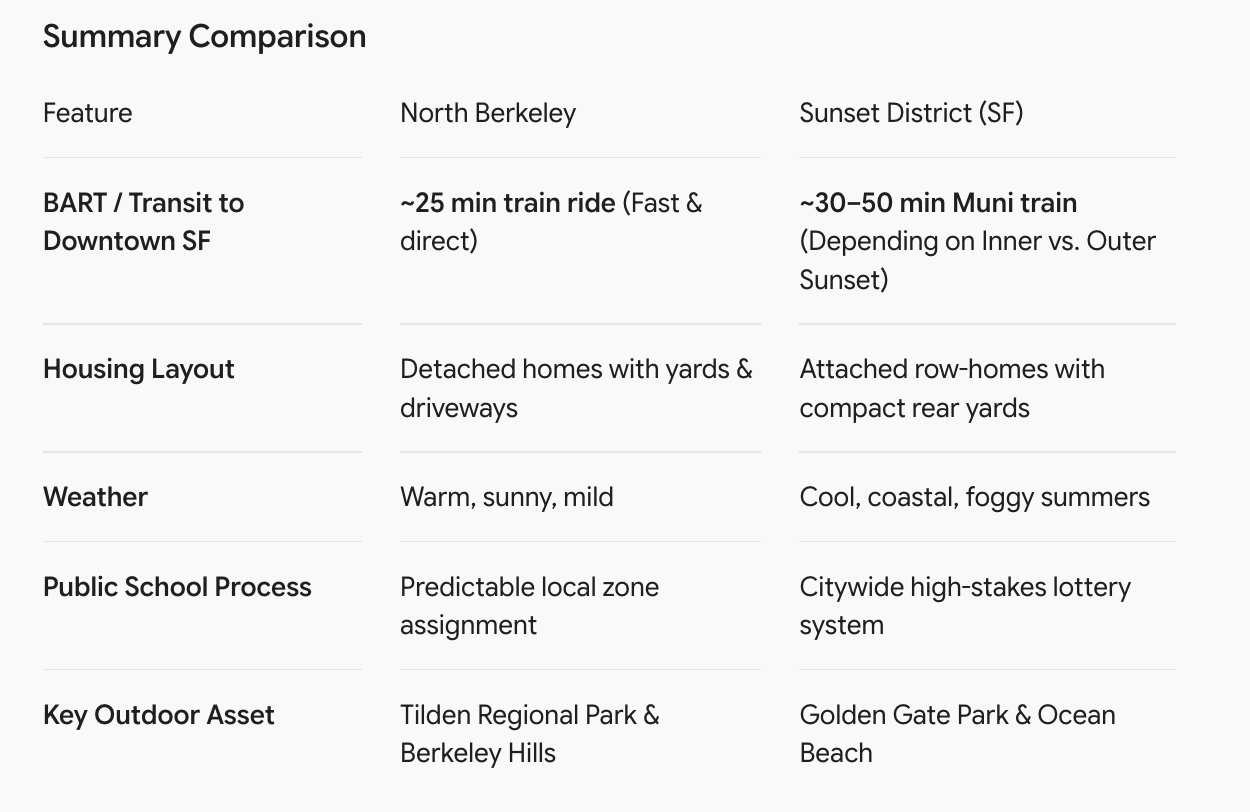
Transit (BART): There are three BART stations in Berkeley: Ashby, Downtown, and North Berkeley. The train ride from the North Berkeley BART station to Embarcadero or Montgomery Station takes ~25 minutes on the train. Door-to-door (including a short walk or bike ride to BART) typically averages 35 to 40 minutes .

Driving: Crossing the Bay Bridge during peak rush hour takes 35 to 60+ minutes , depending on metering lights.

Transbay Bus Routes: Line F, J, and FS (FS is a weekday commute-only express line) take 25-35 minutes from Berkeley to downtown San Francisco.

From the Sunset District:

Transit (SF Muni):

  • Inner Sunset (7th–19th Ave): The N Judah train takes ~25–30 minutes to get underground to Powell/Montgomery stations. Total door-to-door: 35–45 minutes .
  • Outer Sunset (40th Ave to Ocean Beach): The N Judah rides above ground along street traffic, taking 40–50 minutes just on the train. Total door-to-door: 45–60 minutes .

Driving: Driving cross-town via Lincoln Way or Geary Blvd during morning peak hours takes 35 to 55 minutes to reach Market Street.

Public Transportation: N Judah Train takes 25–35 minutes from inner sunset to downtown, N Judah Train or L Taraval takes 35–40 minutes from Central Sunset to downtown, and NX Express Bus or N Judah Train takes 40–50 minutes from Outer Sunset to downtown.

Lifestyle

North Berkeley ("Intellectual, Village-Style Foodie Hub"):

The Vibe: A university town, with tree-lined streets, quiet, highly educated, and culturally steeped around UC Berkeley. Homes are Berkeley Brown Shingle, Mediterranean & Spanish Colonial Revival, Period Revivals (Tudor & Storybook), Craftsman Bungalows, to Mid-Century Modern & Contemporary. Life revolves around the "Gourmet Ghetto" (Shattuck Ave), organic bakeries, historic coffee houses, local bookshops, and neighborhood block parties.

Weather & Terrain: Consistently warmer and sunnier than western San Francisco. Topography ranges from flat lower streets to winding, tree-canopied hills.

Outdoors: Direct access to the trails, redwoods, and views of Tilden Regional Park, Codornices Park, and the Berkeley Rose Garden. And a network of 136 walking paths from the flat to the top of the hills.

The Sunset District ("Coastal, Laid-Back Urban Grid"):

The Vibe: Oceanside, relaxed, and deeply neighborhood-focused. Commercial corridors like Irving, Noriega, and Taraval streets offer fantastic Asian dining, local coffee shops, and surf culture near Ocean Beach.

Weather & Terrain: How often do you see Sunset at the Sunset District? Famously known for the SF summer fog, cooler ocean breezes, and marine air . Terrain is mostly a flat-to-sloping urban grid, making it very walkable locally.

Outdoors: Bordered directly by Golden Gate Park along its entire northern edge and Ocean Beach to the west. Unmatched urban green space and oceanfront access.

Family Life

North Berkeley:

Neighborhood Infrastructure: Homes are almost exclusively detached single-family houses with true front and back yards, private driveways, and side yards.

Kid Dynamics: Highly family-friendly, though hilly pockets in the upper neighborhood mean parents do more driving for playdates. The lower, flatter sections allow easy stroller walks to parks and shops.

The Sunset District:

Neighborhood Infrastructure: Dominated by classic SF "tunnel-entry" row homes on long, narrow lots. Most houses share side walls (zero-lot lines) and have compact rear gardens.

Kid Dynamics: Very safe and family-oriented. Golden Gate Park acts as a massive backyard with playgrounds, the California Academy of Sciences, and soccer fields within walking distance. However, playing outside is usually supervised due to street traffic.

Schools for Kids

School logistics highlight one of the sharpest practical differences between living in Berkeley or San Francisco:

North Berkeley (BUSD - Berkeley Unified):

System: BUSD uses a zone-based assignment system . North Berkeley falls into the Northwest/Central zone, giving families a choice among high-performing neighborhood elementary schools (like Ruth Acty, Cragmont, or Thousand Oaks).

Parent Experience: Transparent, predictable, and localized. Most kids end up at a school within a 5-to-10-minute drive or walk from home, avoiding cross-town commute headaches.

The Sunset District (SFUSD - San Francisco Unified):

System: SFUSD uses a citywide choice lottery . Living in the Sunset does not guarantee your child a spot at a neighborhood Sunset elementary school (like Lawton, Stevenson, or Sunset Elementary).

Parent Experience: Highly complex. Parents tour multiple schools, rank their choices citywide, and await lottery results. If you get assigned to a school across town (e.g., in the Mission or Potrero Hill), morning drop-off requires driving through SF rush-hour traffic. Consequently, many Sunset families opt into private schools when kids reach elementary age.

Public Schools: Assignment Logistics & Stability

School assignment policies are often the single biggest driver of where Bay Area families decide to buy:

North Berkeley (BUSD): Predictable Zone System. Berkeley uses a zone-based assignment model. You choose from a small pool of top-tier neighborhood elementary schools within your geographic zone (like Cragmont, Ruth Acty, or Thousand Oaks). The assignment process is transparent, highly regarded, and rarely pushes families toward private school alternatives.

San Francisco (SFUSD): Citywide Choice Lottery. SFUSD allows families to apply to any public elementary school across the entire city. While intended to promote equity, the process functions like a high-stakes lottery. Parents often spend months touring dozens of campuses, ranking up to 20 options, and awaiting assignments. Many families face cross-town commutes for elementary drop-off or end up opting into SF's expensive private school market.

2. Kid Independence & Outdoor Freedom

North Berkeley: Highly outdoor-centric, but with topography constraints. Kids enjoy playing in front yards and walking to neighborhood parks (like Live Oak or Codornices Park). However, as you move up into the Berkeley Hills, steep winding roads and a lack of sidewalks make biking or walking to school less feasible, meaning parents do more driving.

San Francisco: Dense, vibrant, but closely supervised. Playing outside typically means supervised trips to city parks (like Golden Gate Park, Presidio Tunnel Tops, or neighborhood playgrounds). Kids rarely walk or bike independently to friends' houses or activities until their teenage years due to steep hills, dense traffic, and urban street safety concerns.

3. Daily Logistics: Drop-off, After-School & Weekends

Lifestyle Metric North Berkeley San Francisco
Morning Routine 5–10 minute drive or walk within your zone. Can require a 20–40 minute cross-town commute through city traffic.
Weekend Vibe Hiking Tilden redwoods, visiting Lawrence Hall of Science, farmer's markets. Museums (Exploratorium, Cal Academy), world-class parks, busy city events.
Stroller & Bike Usability 10/10 (100% flat grid with wide sidewalks) in the flatlands; 7/10 (flat in flatlands, steep/narrow in the hills) in the hillier pockets. 5/10 (steep hills, narrow sidewalks, high curb friction).

4. "The Parent Social Network" & Village Vibe

North Berkeley: A rich mix of academic, creative, and professional families. Social life revolves around school communities, youth sports, potlucks, and neighborhood block associations. It feels intellectual, relaxed, and deeply rooted.

San Francisco: Dynamic and diverse, but subject to family turnover. Many parents form close micro-communities within their specific neighborhood or school cohort, but high housing costs and school lottery friction lead many families to move out of the city once their children reach school age.

My Recommendation for Families

Choose North Berkeley if you value top-tier public options alongside immediate access to nature, hiking, cultural enrichment, and an intellectual, foodie-centric community.

Choose San Francisco if you want your kids raised amidst unmatched cultural diversity, world-class institutions, and dynamic city energy—and you are prepared to navigate the school lottery or private school path.

Now let's talk about median housing prices in the two areas:

Market Metrics

Metric San Francisco Berkeley
Median Single-Family Home ~$1.8M – $2.1M ~$1.5M – $1.6M
Price per Square Foot (SFH) ~$1,050 – $1,150+ ~$900 – $950
Condo / Townhome Median ~$1.1M – $1.3M ~$750K – $850K
Average Overbidding 15% – 25% over list 25% – 40%+ over list

2. Value Drivers: What Your Money Buys

Lot Footprints: In San Francisco, single-family homes (especially in grid neighborhoods like the Sunset or Richmond) are predominantly attached row homes on narrow lots with shared side walls. In Berkeley, your dollar typically buys a detached home with a true front yard, private rear garden, and side yards.

Neighborhood Premium Variance:

San Francisco: Premium neighborhoods (Noe Valley, Pacific Heights, Marina) frequently demand $2.5M to $4M+ for a renovated single-family home. Entry-level single-family homes in outer neighborhoods (Excelsior, Visitacion Valley) start around $1.1M–$1.3M .

Berkeley: Prime enclaves (North Berkeley, Elmwood, Berkeley Hills) average $1.6M to $2.2M for character homes. Flatland neighborhoods (West Berkeley, Ocean View) offer entry-level detached starter homes around $950K to $1.2M .

Please contact me if I can help in any way.

Best,
Yun Tong

Sources

Recent Posts

Two-story white house with a double garage, driveway, and landscaped front yard under a blue sky
By Yun Tong & Phillip Campbell • March 16, 2026
A Bay Area trust and probate attorney answers key questions about who can sell a decedent's home, full vs. limited authority, probate timelines, and California's updated $750K property law.
Map of North Berkeley and Normandy Village outlined in orange, with streets and labels visible.
By Yun Tong • March 10, 2026
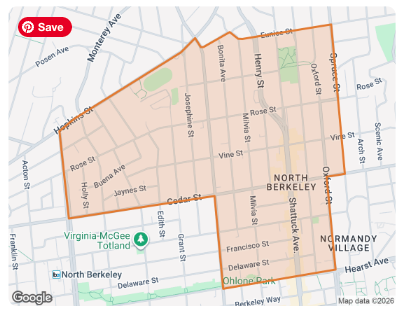
This is what we refer to as the North Berkeley. It is a desirable neighborhood in Berkeley with many beautiful craftsman-style homes, brown-shingle homes, and contemporary homes. Selling a home during the peak real estate selling season is a no-brainer; one wants to sell in a market with many buyers. Spring and early summer have consistently been the peak selling seasons in North Berkeley since 2008. Peak season drives demand higher than at other times of the year. More qualified buyers are on the market, motivated to buy and close before school starts by the end of July and early Aug. (Alameda School District Calendar 2026 - 2027 https://www.alamedaunified.org/family-resources/district-calendar). Put ourselves in the buyers' shoes. There are many approaches sellers take to selling a house: 1. Selling as-is: there are a lot of real estate investors (we call them flippers) looking for projects in this neighborhood. They can turn a dated house around and make a decent profit on resale. Pro: less stress to the sellers. This might be a good way to sell, as the number of real estate investors seeking projects is increasing. Con: The seller might not get the best price. It is a treat off between stress and value. Having a good realtor is crucial when selling fixers; you want to have the right person to negotiate among the investors, getting you the best price. 2. Selling the house in a Moving in Condition: this is to do some necessary repairs, making sure the house has no structural issues, great curb appeal, and leave the last 15% of updates to the new buyers to personalize to their desire. Pro: The seller will get the higher end of the market value of the house. Con: It takes time from a couple of months to a year, an upfront investment, and project management. Some of the homes are well-maintained, with many updates in the last five years. These kinds of houses take the minimum amount of prep work and attract the right buyers for the highest selling price. What the first quarter of 2026 tells us so far is that the market in the North Berkeley area is hot. Many buyers are looking to secure a house in the area and are willing to pay top dollar to compete for the right property. It is a good time to sell, whether the house is a fixer or in better condition. 
Aerial view of a modern hillside home surrounded by lush trees and gardens
By Yun Tong • February 23, 2026
Learn how real estate transactions work during a divorce in California's Bay Area, including community property considerations, tax implications, listing timing, and privacy tips from a divorce real estate specialist.
Deck of a house overlooking trees and a distant cityscape under a blue sky.
By Yun Tong • February 10, 2026
In order to downsize, the seller needs to identify where they will live after moving out of their house. The best time to move is when a seller is still able to make decisions rather than have the decisions made for them due to medical reasons. To downsize usually involves: a financial advisor, a real estate senior rightsize specialist, a home organizer and mover, and sometimes it also involves a home care placement agency or a care home placement specialist. Over the years, I have worked alongside many reputable professionals in senior services. I am happy to be a resource share the network of professionals with anyone who can help you with the rightsizing process. Contact Yun Tong for an initial consultation: Consultation Request